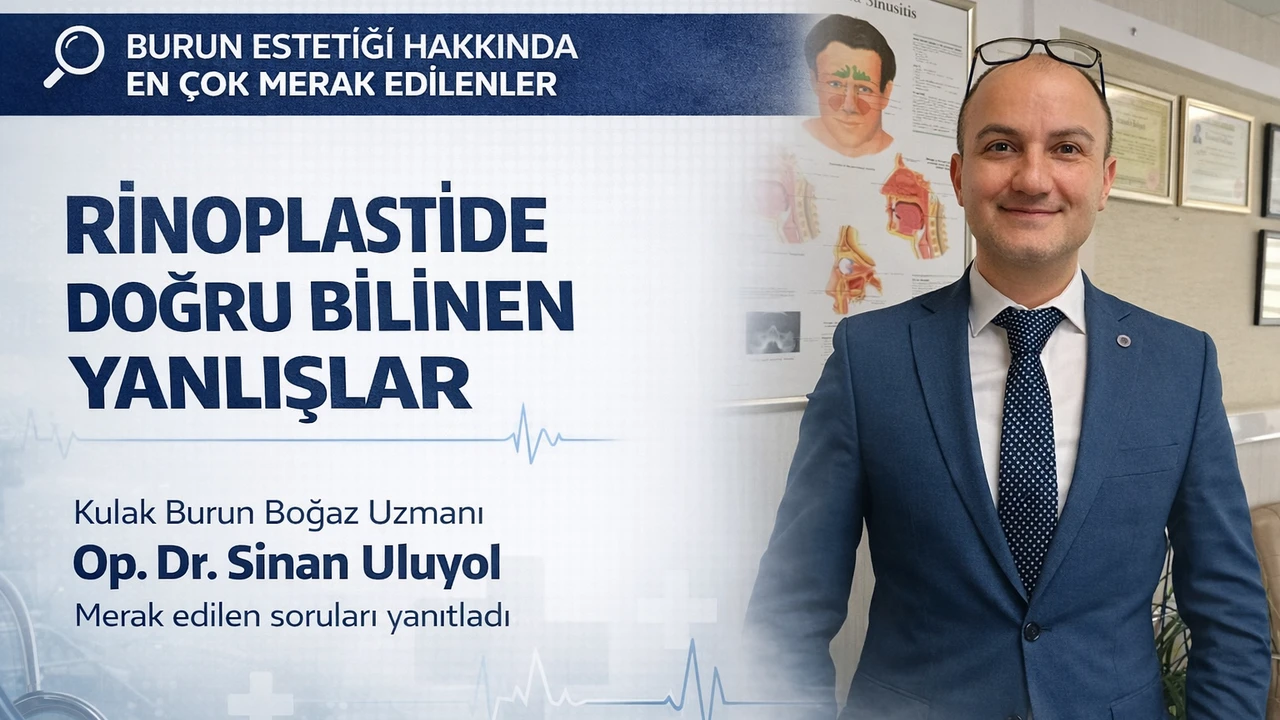
Most Frequently Asked Questions About Rhinoplasty
ENT Specialist Op. Dr. Sinan Uluyol answered the most frequently asked questions about rhinoplasty.
One of the most fundamental principles in rhinoplasty is the age criterion. The minimum age for undergoing rhinoplasty is stated as 18. ENT Specialist Op. Dr. Sinan Uluyol, who works at Özel ENTO Cerrahi Tıp Merkezi, emphasized the legal importance of completing facial bone development before rhinoplasty. He stated that this age limit is 18 and shared important information about nose aesthetics.
Are Swelling and Bruising Normal After Rhinoplasty?
Whether pain, swelling, and bruising around the eyes and face are normal after rhinoplasty is among the most frequently asked questions. Dr. Uluyol stated that during the first two to three days after surgery, color changes such as red, green, yellow, and purple may occur, especially around the eyes. He added that proper ice application, appropriate medication, and sleeping with the head elevated help these symptoms resolve more quickly.
Postoperative Pain After Rhinoplasty
Dr. Uluyol noted that by the end of the seventh day, only slight yellow discoloration may remain, which disappears shortly afterward.
“A throbbing pain may be felt in the central part of the face. When rhinoplasty is performed with minimal tissue trauma, the likelihood of pain is significantly reduced. Rhinoplasty is not a very painful surgery. The minor discomfort experienced is acceptable when aiming for good aesthetic and functional outcomes,” he said.
Advantages and Disadvantages of Rhinoplasty in Thick-Skinned Patients
Addressing whether rhinoplasty is possible in thick-skinned patients, Dr. Uluyol explained:
“Rhinoplasty in thick-skinned patients has both advantages and disadvantages. As a disadvantage, it may not be possible to create a very refined nasal tip because thick skin covers the nasal structures like a blanket. The nasal tip is heavier, and without proper technique, the risk of tip drooping is higher compared to thin skin. Additionally, during the first three months after surgery, thick-skinned patients experience more swelling at the nasal tip, which can be discouraging.”
He continued:
“Despite these disadvantages, there is also an advantage. The final result of rhinoplasty is seen clearly after one to one and a half years. If thick-skinned patients are patient, the outcome is usually very satisfying.”
Does the Nasal Tip Drop After Rhinoplasty?
Dr. Uluyol explained that the nasal tip is mobile because it lacks a bony structure and that with aging, supportive tissues decrease.
“Even without surgery, the nasal tip naturally descends over time. In rhinoplasty, correct positioning of the nasal tip and proper surgical techniques can prevent this issue. Therefore, choosing an experienced and reliable surgeon is crucial,” he stated.
What Should Be Considered When Choosing a Nose Shape?
“There are two key points in rhinoplasty,” said Dr. Uluyol.
“Every nose has its own story. The surgical team understands this during the operation and achieves the closest possible result based on the patient’s wishes. Patients who bring reference photos should consult a surgeon whose previous work they have thoroughly reviewed. Face-to-face consultation is essential. I also recommend meeting with at least two experienced surgical teams to make the right decision.”
The Goal Should Not Be Only Aesthetic Appearance
Dr. Uluyol emphasized that the goal of rhinoplasty is not just achieving a desired appearance but also ensuring nasal health:
“A stronger nose with better breathing should be the objective. During rhinoplasty, we can also correct conditions such as septal deviation. Procedures like radiofrequency reduction of the nasal turbinates are routine. If conditions such as nasal polyps or sinusitis are present, they can often be treated during the same operation.”
What Are the Techniques Used in Rhinoplasty?
Regarding open and closed techniques, Dr. Uluyol said:
“Patients want a well-shaped nose that lasts long and allows comfortable breathing. The theoretical technique itself is not important; what matters is a trustworthy surgical team. When properly performed, swelling and bruising are minimal regardless of the technique.”
A Reminder for Patients With Septal Deviation
Dr. Uluyol concluded with an important warning for patients considering rhinoplasty in the future:
“We never recommend septoplasty alone for patients who may want rhinoplasty later. If septal cartilage is removed beforehand, there may not be enough cartilage for rhinoplasty. In such cases, cartilage must be taken from the ear or rib, which has its own risks. Therefore, if you are considering rhinoplasty, do not undergo septal cartilage surgery beforehand.”