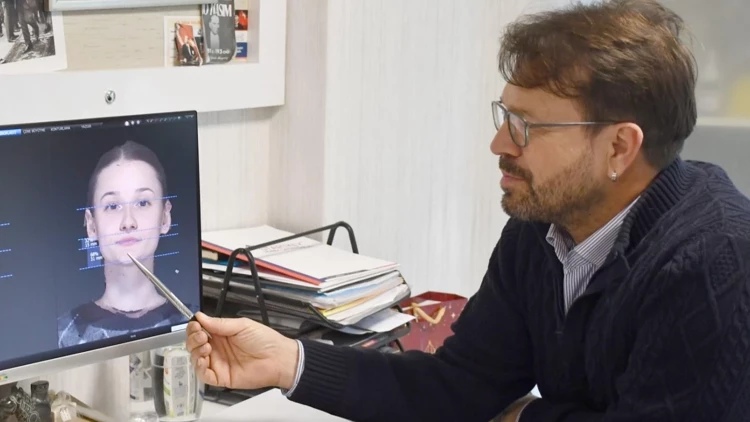
Advanced Technology in Preoperative Rhinoplasty Planning: 3D Simulation
ENT Specialist Op. Dr. Ümit Filiz stated that advanced technologies used in rhinoplasty surgeries make the surgical planning process healthier and significantly facilitate patients’ decision-making stages.
ENT Specialist Op. Dr. Ümit Filiz from Özel ENTO Kulak Burun Boğaz Cerrahi Tıp Merkezi emphasized that unlike conventional two-dimensional photo simulations, advanced digital imaging systems offering three-dimensional facial analysis and simulation provide great convenience for both patients and surgeons during preoperative rhinoplasty evaluations. He stated:
“This system scans the patient’s face in three dimensions within seconds using specially designed high-resolution cameras and transfers the entire facial anatomy into a digital environment in detail. The resulting image is not just a photograph; it is a comprehensive facial model that allows measurements, multi-angle examination, and proportional analysis. Since the anatomical structure is analyzed in all its details, communication between patient and surgeon becomes clearer and more reliable. This enables expectations to be defined clearly before surgery and allows for more accurate planning. Being able to visualize the targeted nasal shape before the operation ensures a more controlled and predictable surgical process and significantly reduces the need for secondary or tertiary revision surgeries.”
Dr. Filiz also noted that this model allows detailed evaluation of critical aesthetic parameters such as the nasal hump, nasal tip projection, nasolabial angle, facial symmetry, and chin–nose balance.
“Unlike other simulation methods, this system does not merely offer a visual prediction; it provides a measurable, analyzable, and scientifically based planning opportunity,” he said.
Approximate Surgical Outcome Can Be Visualized Preoperatively
Stating that one of the most important elements in rhinoplasty planning is achieving a balance between patient expectations and the surgeon’s assessment of natural and anatomical limits, Dr. Filiz explained that three-dimensional simulation serves as a powerful communication tool at this stage.
He noted that surgeons can simulate planned modifications on the digital model—such as smoothing the nasal bridge, lifting or reducing the nasal tip—and present these changes visually to the patient.
“This allows the patient to gain a more concrete and realistic idea of the possible postoperative appearance. The process becomes more transparent, and expectations are clarified,” he said.
Dr. Filiz also emphasized that the three-dimensional system provides not only aesthetic but also functional data, allowing clearer identification of asymmetries, deviations, and proportional disharmony with other facial structures. He stressed that digital simulations do not guarantee exact results:
“The final postoperative appearance depends on many factors such as skin thickness, tissue elasticity, healing process, and surgical technique. However, 3D imaging makes the process more predictable, increases patient satisfaction, and offers surgeons a more controlled roadmap during the planning phase.”